IT Strategy
AI Doesn't Solve Your Problems. You Do.
AI speeds up whatever decision you already made. It does not make the decision for you. Here's why the tool amplifies judgment instead of replacing it, with real business examples.
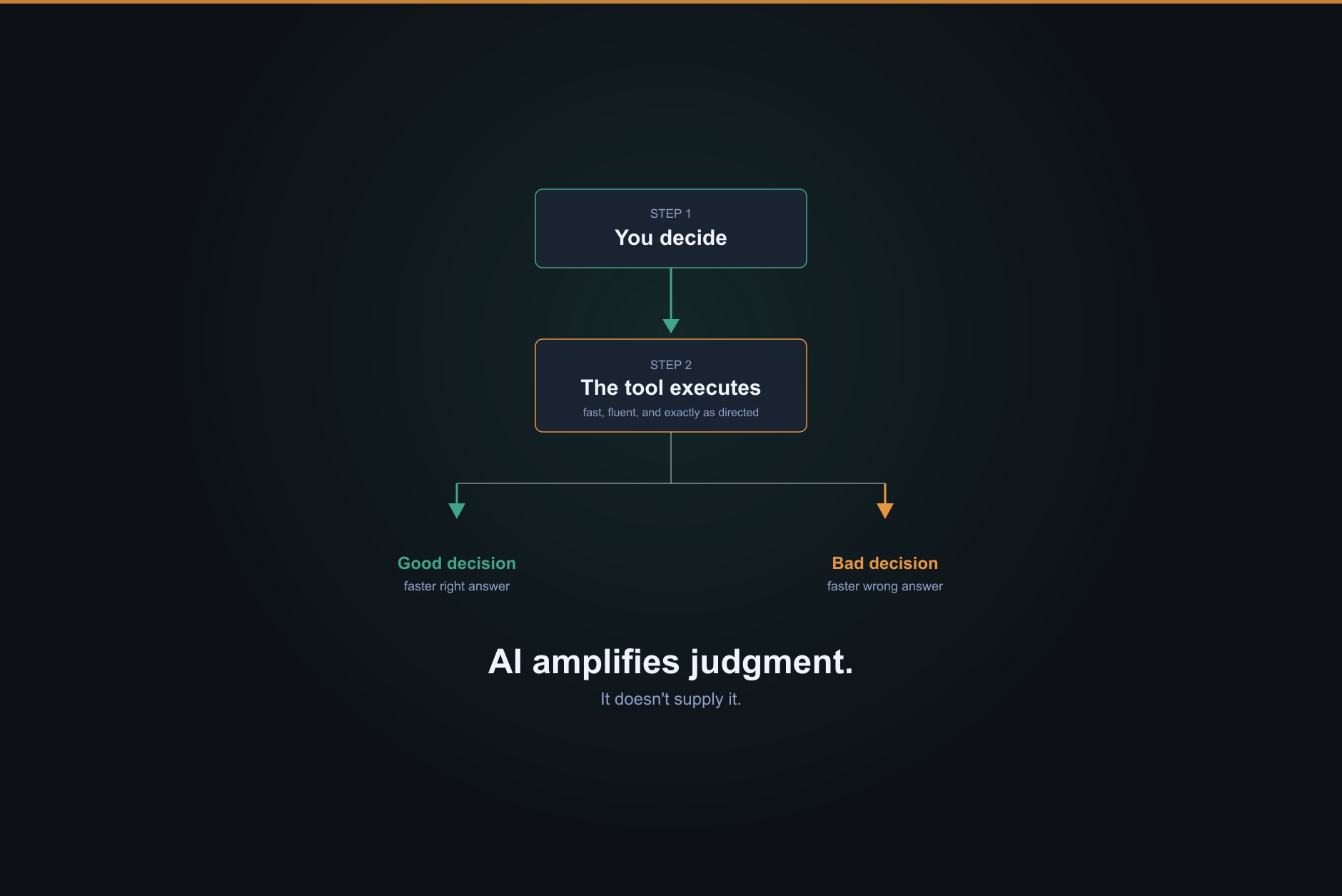
No. AI speeds up whatever decision you already made. If the decision was sound, AI gets you there faster. If the decision was wrong, AI gets you to the wrong answer faster, with better spelling. The tool amplifies judgment. It doesn’t supply it.
That’s a hard thing to hear when every vendor pitch tells you the opposite. So let’s walk through why it’s true, using the kind of decisions a business owner actually makes, not server rooms or IT tickets.
Does AI actually solve business problems?
Not on its own. AI can draft, summarize, and generate options faster than a person can. What it can’t do is know what your business is trying to accomplish this quarter, which customer relationship you can’t afford to damage, or which corner is safe to cut and which one isn’t. Those are judgment calls. You make them, or someone on your team does. AI just executes whatever direction it’s given, and it executes badly-thought-out direction just as fluently as good direction.
This is the part most AI coverage skips. A tool that produces confident, well-formatted output feels like it’s thinking. It isn’t. It’s pattern-matching against your input. Feed it a clear, specific brief and you get something useful back in a fraction of the time. Feed it a vague one and you get something that reads well and does nothing for you.
What happens when the priorities going in are wrong?
You get the wrong answer, faster and more convincingly. This is the part that catches people off guard, because bad output from an AI tool doesn’t look bad. It looks polished.
Take a marketing draft. Say you ask an AI tool to “write some posts to get more engagement.” It will. They’ll be grammatically clean, reasonably on-brand, and completely disconnected from what’s actually driving your sales, because nobody told the tool what’s driving your sales. You didn’t decide who the posts were for or what you wanted the reader to do next. The tool couldn’t have known that. It answered the question you actually asked, which wasn’t the question you meant to ask.
Same pattern with customer replies. An AI-drafted response to an upset customer can sound calm and professional while completely missing that this is their third complaint this month, or that they’re a client worth keeping regardless of who’s technically right. The tool doesn’t carry that context unless a person puts it there first, and it won’t flag that it’s missing. It will just answer.
Forecasting is the clearest version of this. Run your numbers through an AI tool and it will hand back a projection that looks rigorous, complete with a clean narrative explaining the trend. If the inputs were optimistic, or a one-time contract got counted as recurring revenue, the projection is wrong in a way that’s very easy to act on, because it doesn’t look wrong. It looks like math.
How do you tell good AI output from bad AI output?
You usually can’t, not by reading it. That’s the uncomfortable part. A forecast built on a bad assumption and a forecast built on a solid one can come back looking identical: same charts, same confident tone, same clean formatting. The tell isn’t in the output. It’s in whether someone checked the inputs before the tool ever ran.
This is why “just have AI look at it” isn’t a review process. A second AI pass will catch a formatting error. It won’t catch that the underlying assumption was wrong, because it has no way to know your business well enough to notice. Catching that requires a person who knows the account, the customer, or the number well enough to ask “does this actually match what I know to be true?” That step doesn’t go away because a tool got faster.
Where does AI actually help, then?
Everywhere the judgment call has already been made and the work left is execution. Once you’ve decided what the marketing post needs to say and to whom, AI can produce five versions of it in the time it takes to write one by hand. Once you’ve decided how a customer complaint should be handled, AI can draft the reply for a human to read, adjust, and send. Once you’ve built a forecast model with the right assumptions, AI can run the scenarios faster than a spreadsheet chain ever could.
The pattern holds across every use case worth taking seriously: AI is excellent at execution and unreliable at judgment. Businesses that get value from it are the ones that keep those two things separate, deciding first, generating second, and reviewing before anything goes out.
Why doesn’t Helix Stax just sell you an AI tool and call it done?
Because that would be a much easier sale, and a worse answer. Helix Stax runs managed IT, strategy, projects, and AI work as one practice, and most businesses are sitting on AI they’ve already paid for and aren’t using: Gemini bundled into a paid Google Workspace plan, Copilot Chat included in Microsoft 365 Business. Pointing that out first, before selling anything new, is the honest answer even when it’s the smaller sale. When a client’s confidentiality or compliance obligations rule out a public AI tool, Helix Stax runs the same self-hosted stack it recommends, on infrastructure the client controls, which changes how that obligation gets met, not whether it still applies. Either way, the answer starts with what you’re actually trying to fix, not with which tool gets sold this quarter.
That structure also shapes how Helix Stax measures readiness. The CTGA framework, short for Controls, Technology, Growth, and Adoption, scores a business’s overall maturity for adopting technology well, on a 100 to 900 scale (the lowest score you can receive is about 260). It’s a business-adoption score, not a cybersecurity rating, and it isn’t built to be compared to one. Its job is to force the prioritization question before any tool gets recommended: what are you actually trying to fix, and is your organization ready to use a tool to fix it. That’s the judgment step. AI still can’t do it for you.
What should a small business owner actually do about AI right now?
Start with the decision, not the tool. Before you touch an AI product, write down what you’re actually trying to fix and what “better” would look like if it worked. If you can’t answer that in a sentence, no tool is going to answer it for you, no matter how capable the model is.
Then treat AI output the way you’d treat a draft from a new hire: useful, fast, and not yet ready to ship without a second set of eyes. That habit alone prevents most of the damage AI causes in small businesses, which usually isn’t a technology failure. It’s an unreviewed decision that moved faster than anyone checked it.
None of this means slow down and avoid AI. It means put the thinking first and let the tool do what it’s actually good at, which is turning a clear decision into finished work quickly. The businesses getting real value out of AI right now aren’t the ones with the fanciest tools. They’re the ones who were already clear on their priorities and just needed execution to catch up to that clarity.
If you’re not sure which category you’re in yet, that’s worth a conversation before you spend money finding out the hard way. Book a call and we’ll talk through what you’re actually trying to fix.
Read more

IT Strategy
What Does a vCIO Do (and Does Your Business Need One)?
A virtual CIO handles IT strategy, roadmap, budget, and vendor decisions for growing businesses. Learn what a vCIO actually does week to week and when it makes sense.

Automation
Do You Need a Private AI Server? A Plain Answer
When a private AI server makes sense for a small business, when a vendor plan is enough, and why self-hosting moves your duties instead of removing them.

Cybersecurity Compliance
IT Support for Accounting Firms and the FTC Safeguards Rule
What the FTC Safeguards Rule asks of tax and accounting firms, which parts are IT work, and what to ask an IT provider. A plain guide for Hampton Roads.
Frequently asked questions about Helix Stax managed IT services
No. AI can generate options, draft text, and summarize information faster than a person can, but it doesn't know your priorities, your customers, or what tradeoff you're willing to make. Someone still has to decide what the business needs before AI is useful, and someone still has to check the output before it goes out the door.
Usually because the brief was vague. AI tools produce fluent, confident-sounding copy regardless of whether the underlying strategy is right. If you ask for 'more social posts' without deciding who they're for or what action you want, you get more posts, not more results. The tool followed instructions. The instructions were the problem.
That's usually when it matters most. Larger companies have someone whose job is to catch a bad automation before it costs money or damages a customer relationship. A small business owner is often making that call alone, after hours, without a second opinion. An outside assessment exists to be that second opinion.
CTGA stands for Controls, Technology, Growth, and Adoption. It's a business-adoption maturity score that measures how ready an organization is to use technology well across those four areas. It is not a cybersecurity rating, and it isn't meant to be compared to one.