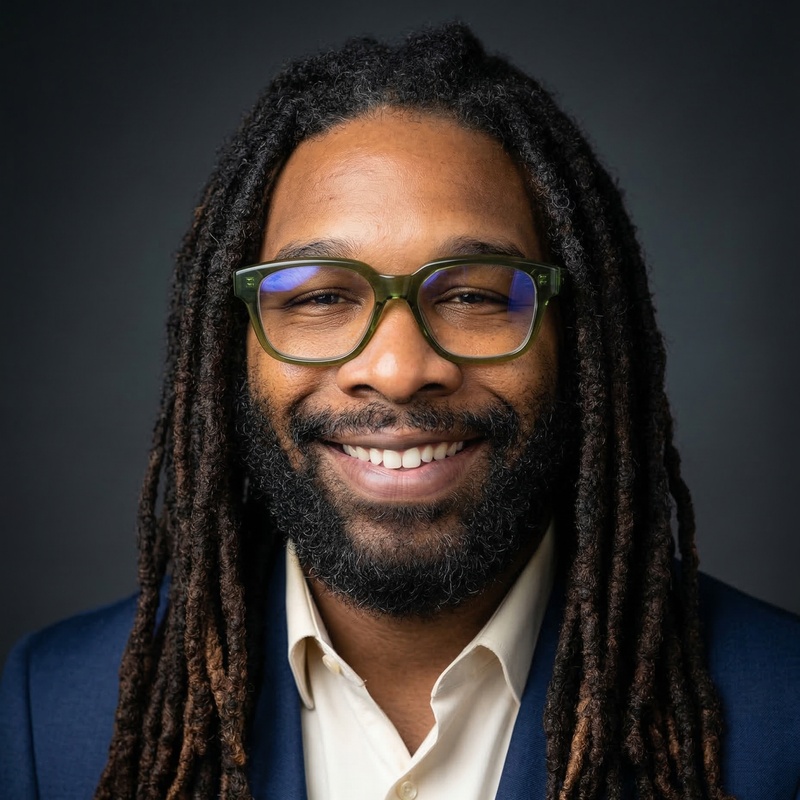
Founder, Helix Stax
I'm Wakeem Williams. I built Helix Stax to close a gap that keeps costing Hampton Roads businesses.
We bring the same technology discipline that enterprise companies run on to small and mid-size businesses across Hampton Roads, at a price and a pace that actually make sense for your operation.
Wakeem Williams, Founder
My story
How did Wakeem Williams start an IT consulting firm?
Years ago I ran my own clothing company. Not a side project. An actual business with real customers, real orders, and the real pressure that comes with it. I tracked everything by hand. Orders lived in spreadsheets. Customer follow-up meant me, sitting down, going through a list, sending messages one at a time. Inventory I kept in my head, which works fine until it does not. Returns, reorders, supplier conversations, shipping logistics. All of it landed on me.
I did not think of it as a technology problem. I thought of it as hustle. That was just what running a small business looked like.
At some point I found out most of that could have been automated. Not in some theoretical, futuristic way. The tools existed. They were available. They were affordable. They were just aimed at companies with IT departments and dedicated operations staff, not at owners working out of spreadsheets at 11 PM. Nobody had sat down with me and said, here is what is possible, here is what it costs, here is what you would get back. I had to stumble into it on my own. That stayed with me.
So I decided to learn it from the inside. I went and worked in large organizations, supporting enterprise environments at real scale. I saw more technology than most small businesses will touch in a decade. I saw it deployed, misused, underused, and completely ignored. I saw teams with six-figure software budgets and the same problems the clothing company had, just at a different price point.
The gap was never the tools. The gap was between what got deployed and how people actually worked. I watched organizations roll out platforms nobody adopted because nobody explained them. I watched compliance initiatives get treated as checkbox exercises until they became emergencies. I watched automation projects stall because the people who approved them were not the people who had to use them.
What I kept thinking was this. Small businesses do not have the budget to make these mistakes. They get one shot. When a technology decision goes wrong for a company with an IT department, it costs them time and money. When it goes wrong for a small business owner, it can cost them the business.
I learned all of this the slow way. Running the business by hand, then going and getting the knowledge from the inside, one hard lesson at a time. That took me years. You should not have to spend them. The whole reason Helix Stax exists is to get you there faster, to hand you the shortcut I had to go find.
I started Helix Stax to carry what I learned in those rooms back to the owners and operators who never had access to it. Not a watered-down version. The real thing, translated into something that makes sense for a 20-person operation or a 100-person operation that does not have an IT director on payroll.
Why do small businesses lag so far behind on technology?
10x
That is roughly the distance between what a large enterprise does with technology and what most small businesses even know is possible. And it is not stable. It is growing. AI is widening it faster than anything since cloud computing changed everything in the early 2010s.
The businesses I talk to in Hampton Roads are not using automation. Not because they evaluated it and decided it was not worth it. Because nobody has ever shown them what is available. They are manually entering data between systems that could talk to each other. They are chasing approvals by email for things that should route themselves. They are rebuilding the same report by hand every week when it could run on its own and land in their inbox before they get to work. They are paying people to do work machines should do, and those people know it.
The cybersecurity picture is the same. Large companies have dedicated security teams and tooling that costs more per year than most small businesses generate in revenue. Small businesses here, especially defense contractors, are expected to meet the same standards, CMMC, NIST 800-171, HIPAA, on their own, usually after a compliance questionnaire lands in their inbox and they realize they are not ready.
Then there is the data problem. Most small businesses are sitting on data they never use. Customer history, transaction patterns, operational signals that could tell them something real about their own business. It sits in their accounting software or their CRM or their point of sale, and nobody ever set it up to be looked at.
The tools to close all of this exist. Cloud done right is not expensive. Workflow automation is not complicated when someone who knows it walks you through it. An AI build that fits your operation is not science fiction. The reason these things are not deployed everywhere is not price. It is the knowledge gap. The people who know how to do this work are mostly employed by companies that already have it, and the firms that could help small businesses usually charge enterprise rates. AI is making this move faster. Every month without a structured approach to your stack is a month the businesses already using these tools pull further ahead.
What does a full-service managed IT provider actually do?
We work across four areas. Most clients need more than one. What connects them is a single methodology, the CTGA Framework, which scores your technology maturity across all four domains and gives you one number, the Helix Score, that tells you where you stand.
Managed IT and Support is the foundation. Networks, devices, endpoints, software, Microsoft 365, cloud infrastructure, and the helpdesk that answers when something breaks. When it is handled properly it runs invisibly. When it is handled poorly your people spend an hour on hold before a ticket gets escalated. We deliver it directly or through vetted partners we manage ourselves, with 24/7 monitoring and a response structure built for businesses that cannot afford downtime.
Cybersecurity and Compliance is the layer most small businesses underinvest in until they cannot. For defense contractors, CMMC and NIST 800-171 are contractual requirements. For healthcare-adjacent businesses, HIPAA is not optional. For everyone else, basic security hygiene is the difference between a near miss and a breach. We build the controls, write the policies, run the assessments, and help you demonstrate compliance in a way that holds up. We do not do checkbox compliance.
IT Projects and Automation is where the meaningful change happens. Migrations, integrations, workflow automation, AI deployments, and custom builds that connect systems you already own. Three tools that do not talk to each other, we fix that. A manual process your team repeats every week, we automate it. A private AI instance on your own infrastructure so your data never leaves the building, we build that. These are the projects that buy back hours and build capability your competitors do not have yet.
IT Strategy and vCIO is technology leadership without a full-time executive on payroll. A roadmap, a vendor evaluation process, a real technology budget, and a plan for what you need in two years and how you get there. Every growing business needs this, and most are making these calls informally, under pressure, without a framework. We bring the framework and sit in the room when decisions get made.
We also do specialty work where we have built real depth: private and self-hosted AI hosting for businesses with data sensitivity concerns, networking and infrastructure builds, cloud and Microsoft 365 migrations and management, backup and disaster recovery planning, and marketing and sales automation for firms that want their pipeline running on systems instead of memory.
-
Managed IT and Support
The day-to-day foundation: networks, devices, software, and the people who rely on them. We keep everything running so you can focus on the business.
-
Cybersecurity and Compliance
Security controls, policies, and the CMMC and NIST 800-171 readiness that keeps you in the defense supply chain and off the breach report.
-
IT Projects and Automation
The work that moves the needle: migrations, integrations, AI deployments, and the automation that buys back hours your team is currently spending manually.
-
IT Strategy / vCIO
Technology leadership in the room without a six-figure salary on the books. Roadmaps, vendor decisions, budget planning, and someone who can actually explain the trade-offs.
The CTGA Framework and your Helix Score
CTGA stands for Controls, Technology, Growth, and Adoption. Controls covers your security posture, compliance alignment, and governance. Technology covers your infrastructure, tool selection, integration readiness, and data. Growth covers the technology decisions tied to revenue: your pipeline, your customer systems, your ability to scale. Adoption covers whether your team actually uses what you have, and whether your organization is ready to use what you need.
The Helix Score runs from 100 to 900. We designed it to feel like a credit score because a credit score means something to an owner and to a leadership team. You know instantly whether 420 is concerning and whether 680 is good. You can track it over time and show it to a board, an investor, or a contracting officer and they know what they are looking at. We run the assessment, hand you the number, identify your three highest-impact gaps, and work them. Then we run it again.
What does working with an IT consulting firm actually look like?
The first conversation is free. No pitch deck, no discovery call built to close you. We sit down and talk about your business. What you are dealing with, what you have tried, what keeps coming up. By the end you have a rough sense of your Helix Score and your top three gaps, and you understand what it would take to close them. You do not owe us anything for that.
If it makes sense to go further, the next step is a formal CTGA assessment across all four domains. We look at what you have deployed, how your team actually uses it, where your compliance posture stands, and where the biggest drags on your operation are hiding. The output is your Helix Score, a prioritized gap report, and a roadmap in plain language. Not a 60-page report that sits on a shelf. A working document.
From there, engagements take different shapes. Some clients want us embedded, with regular hours and someone in the room for technology decisions, closer to a vCIO or managed services relationship. Others have a specific project: a migration, a compliance readiness program, an automation build, a security audit. We scope it, price it, and deliver it. We do not pad engagements to keep the hours running.
As we work the gaps, we re-score. If we fixed something in your Controls domain, the score reflects it. If your Adoption numbers are not moving, we know the implementation is not sticking and we adjust. The score is the accountability mechanism, for you and for us.
A few things are non-negotiable on our end. We tell you what we see, including what you might not want to hear. We do not hide gaps to extend an engagement. We do not sell you tools we do not believe in. And we do not build you something and then take it with us when we leave. Everything belongs to you: the documentation, the configurations, the automations, the accounts. Working with Helix Stax means you work with me, not a junior consultant handed a methodology.
What kinds of businesses does Helix Stax work with?
Hampton Roads is economically complex. A large defense and federal contracting base, hospitality and tourism on the oceanfront, professional services across all seven cities, manufacturing, and a growing technology sector. Underneath all of it are thousands of small and mid-size businesses running on determination, tribal knowledge, and software that was never designed to work together. That is who we work with.
-
Defense contractors facing compliance pressure
CMMC is not optional in the defense supply chain, and it is not forgiving. A Newport News contractor that does not meet NIST 800-171 does not get renewed. The work is real and it requires someone who understands both the technical requirements and how a small organization actually operates. We know where the gaps usually are and how to build programs that hold up to an audit without grinding your operation to a halt.
-
Hospitality operators managing complexity
A Virginia Beach hotel or restaurant group usually runs three to five systems that do not communicate: property management, point of sale, booking, payroll, reputation. Each has its own login, its own data entry, its own export. We integrate them, automate the reporting, and build the infrastructure that lets an operator see the whole business in one place instead of five.
-
Professional services firms running on spreadsheets
Law firms, accounting firms, financial advisors, consultants. Smart people, complex work, and operations that were never designed to scale. The practice grows but the systems do not. Onboarding by email, client records in a dozen places, follow-up that depends on someone remembering. We build the systems that make the firm run the way it should.
-
Growing businesses that outgrew their tools
Any business that started small, built workarounds as it grew, and now runs on a stack of software and manual processes that made sense at the time and do not anymore. This is the most common thing we see. The business is successful. The technology is holding it back.
Why does the founder's background matter for your IT program?
I trained through Harvard and MIT programs to build the analytical foundation behind the CTGA Framework. I developed it from direct experience supporting enterprise environments like Xfinity, where I watched what happens when technology meets a real organization at scale: what works, what quietly fails, and what looks good in a presentation but never gets used. The framework is not theoretical. It is built from what I actually observed, turned into a scored, repeatable assessment a small business owner can act on.
I built a framework instead of just doing consulting because I wanted the methodology to be the accountability mechanism, not my judgment. When a consultant tells you what to fix, you are relying on their opinion. When a framework scores you across the four CTGA domains and shows you where you rank on a 100 to 900 scale, the data does the talking. You have something to track if you want to show progress, and something to show a board or a contracting officer if you need to demonstrate technology maturity.
The CTGA Framework is built around the same control standards small businesses here actually face, including NIST 800-171 for defense contractors. That was deliberate. Most IT consultants treat compliance as a separate track from technology strategy. We treat them as the same thing, because your security controls are your business controls.
Helix Stax is a minority-owned firm, founded and led by me, based in Portsmouth, Virginia. I am not a franchise and there is no parent company. This is the firm I built and the work I do. When you work with Helix Stax, you work with the person who built the method, and the work stays with you when we are done.
Recognized by Clutch
Clutch named Helix Stax a Top Company for 2026 across eight categories, from managed IT to AI consulting. The ratings come from verified client interviews, not self-reported reviews.





Where we work
Why does Helix Stax focus on Hampton Roads IT support?
Helix Stax works out of Portsmouth and covers the full seven-city Hampton Roads region. We stay local because local is where we can actually do this work well.
A national IT firm reads your business off a discovery call and sends a technician who has never sat in the Hampton Roads Bridge-Tunnel at 5 PM. I already know the defense contractors in Newport News working backward from a CMMC deadline, the hospitality operators on the Virginia Beach oceanfront managing check-in across three systems with seasonal staff, and the professional services firms in Norfolk running the whole operation off one partner's spreadsheet that nobody else fully understands. This is the region, not invented examples.
Local also means accountability. There is no offshore support tier and no ticketing system you never hear back from. When something breaks, you talk to us.
Our honesty policy has three parts. We tell you what we see on the first call, including what you might not want to hear. We do not pad engagements with work designed to keep us in the building. And we do not sell tools we do not believe in, which in practice means we sometimes tell clients they do not need what they think they need and show them a simpler, cheaper path.
When we build you something, it belongs to you. The documentation, the credentials, the configurations, the automations, the accounts, all of it. If you decide later to bring IT in-house or switch providers, you leave with everything. No hostage code, no lock-in that conveniently requires us to maintain it. We build things so someone else could understand them if they had to. That is not how every IT firm operates. It is how we operate.
Building the next generation of Hampton Roads IT professionals.
Helix Stax is building a Registered Apprenticeship program. We hire locally and train people into IT roles with real credentials, not just certifications-of-the-week. It takes longer than hiring experienced staff. It is worth it.
It is how we stay connected to the community we serve, and it is how we keep our team from becoming the kind of firm that treats clients differently depending on contract value.
In Wakeem's words
"When I ran my clothing company, I didn't know automation existed. I built Helix Stax so that gap doesn't cost the next owner the same years it cost me."
Free, no commitment
See where your IT actually stands.
Book a free assessment call. No charge. You walk away with your top three technology gaps written down and an estimated Helix Score.
Book My Free Assessment